Social security bodies (CAF, CPAM)
Challenge: front-desk staff worn out by aggressive behaviour from some service users.
Outcome: a calmer team and a clearer approach to welcoming the public.














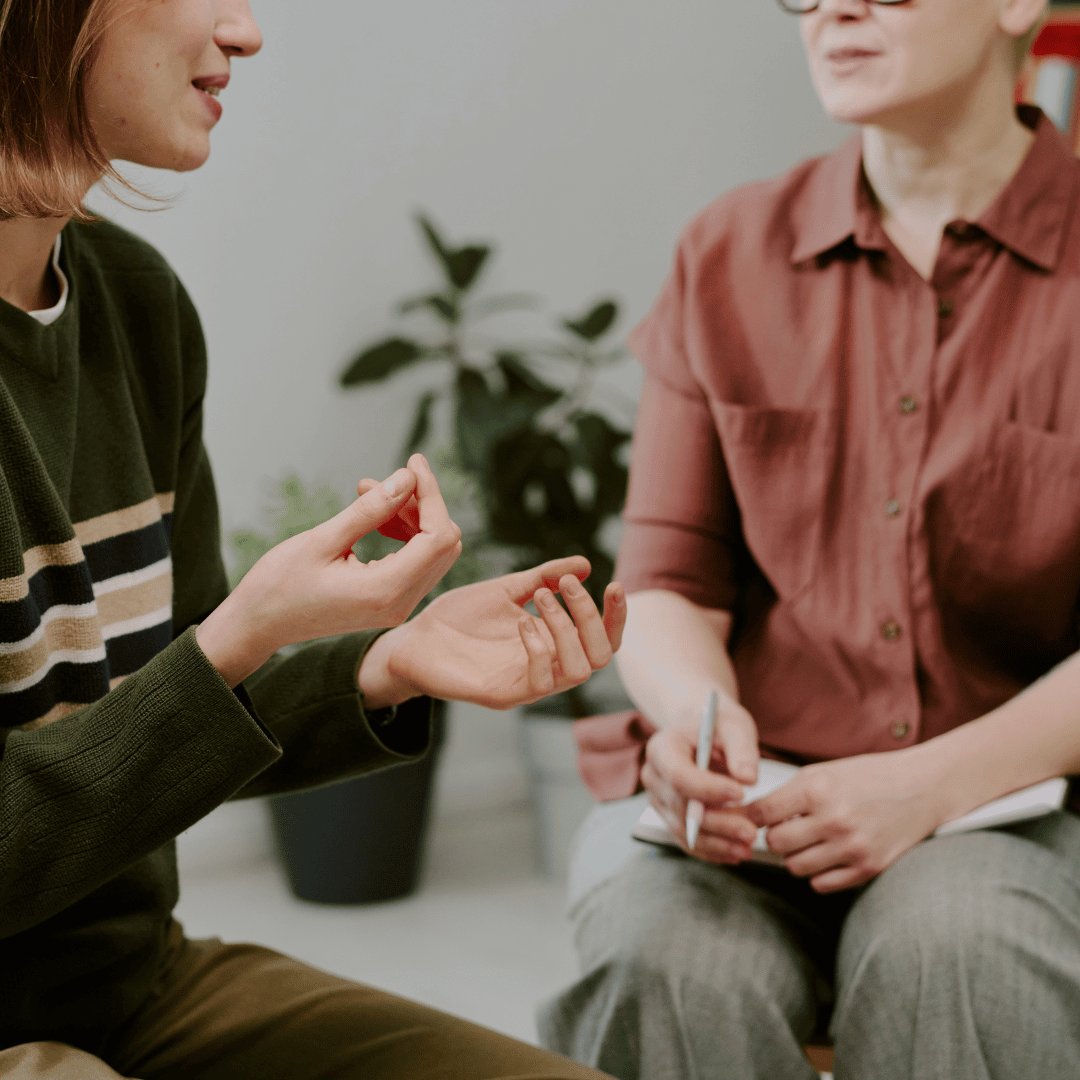
▸ Analyze real-life situations to gain perspective, question your approach, and harmonize professional practices.
Objectives:
• Use real-life situations to understand the underlying factors of an intervention.
• Adjust your approach by questioning your perceptions and automatic reactions.
• Build a common culture and shared professional standards.
Practical details: groups of 6 to 10 participants, cross-disciplinary or by department · 2 to 3-hour sessions every 4 to 6 weeks, over 10 to 12 months · led by an expert in group dynamics and the APP method.
Who it's for: field teams, social and medico-social workers, reception staff, and caregivers.
▸ A clinical space to process emotional burdens and complex relational dynamics.
Objectives:
• Manage the emotional burden of dealing with distress and its impact on the professional.
• Shed light on institutional dynamics and the psychological distress involved in caregiving.
• Prevent psychosocial risks, particularly compassion fatigue and vicarious trauma.
Practical details: small groups of 5 to 8 people · 2-hour sessions, held monthly or bi-monthly · led by a clinical psychologist, psychotherapist, or psychoanalyst.
For whom: social and medical sectors, child protection, healthcare workers, and child psychiatry.
▸ A collective intelligence method for concretely solving operational or managerial challenges.
Objectives:
• Following a proven method: the Payette and Champagne method, consisting of 6 steps (presentation, clarification, contract, consultation, synthesis, and learning).
• Taking action: a "client" participant presents their issue, while "consultants" provide questions and potential solutions.
• Helping one another by developing active listening and co-construction.
In practice: group of 6 to 8 peers · 2 to 3-hour sessions, one situation explored in depth per session · facilitator trained in collective intelligence.
For whom: public and private sector managers, department heads, project managers, and professional networks.
▸ A space for listening and mutual support after a crisis, a traumatic event, or a period of burnout.
Objectives:
• Expressing oneself freely and safely, without evaluation or production goals.
• Sharing feelings following a serious incident, a death, or a major reorganization.
• Rebuilding bonds: breaking isolation, normalizing stress reactions, and restoring collective trust.
In practice: group size adjusted during scoping · 2-hour sessions, either one-off or as a series · facilitated by a psychologist.
For whom: any group facing a traumatic event, major uncertainty, or shared burnout.


Confidentiality, kindness, non-judgment, and equal speaking time.
A participant, or the group, shares a real-life situation or a field-related issue.
The group examines the facts, feelings, context, and interactions.
New hypotheses emerge, and the situation is viewed from a different angle.
Concrete solutions that can be applied in the field.
Key takeaways are formalized to enrich the team's practice.
Psychologists, clinicians, and HR and management experts, selected for their dual clinical and methodological expertise and their knowledge of your professional environment.
We define your needs with you to determine the most suitable format or the right combination.
Format, frequency, and group composition are adjusted to your organization, whether it is a social agency, local authority, healthcare facility, or private company.
Satisfaction, feedback, and QWL indicators are tracked via our digital management platform. The benefits are measurable at every level: professionals are less prone to burnout, teams are more cohesive, absenteeism and turnover decrease, and the quality of service for users improves.
FAQ
No. It is a professional space for analyzing work situations, centered on practice and professional conduct. It is not individual therapy. If a need for personal support arises, the facilitator can refer the professional to appropriate resources.
No. It is a professional space for analyzing work situations, centered on practice and professional conduct. It is not individual therapy. If a need for personal support arises, the facilitator can refer the professional to appropriate resources.
Practice analysis focuses on the work situation itself: what happened, how you intervened, and what could be done differently. Supervision focuses more on the emotional and psychological impact of the situation on the professional and is led by a clinical psychologist, psychotherapist, or psychoanalyst.
Practice analysis focuses on the work situation itself: what happened, how you intervened, and what could be done differently. Supervision focuses more on the emotional and psychological impact of the situation on the professional and is led by a clinical psychologist, psychotherapist, or psychoanalyst.
Yes. Confidentiality and a non-judgmental environment are established at the start of every session. The facilitator is external to your organization and does not report on the content of the discussions.
Yes. Confidentiality and a non-judgmental environment are established at the start of every session. The facilitator is external to your organization and does not report on the content of the discussions.
You don't have to choose alone. An initial assessment determines the most suitable format (practice analysis, supervision, co-development, or support groups), or the most effective combination.
You don't have to choose alone. An initial assessment determines the most suitable format (practice analysis, supervision, co-development, or support groups), or the most effective combination.
It depends on the format. Practice analysis sessions typically span 10 to 12 months, with a meeting every 4 to 6 weeks. Supervision follows a monthly or bi-monthly schedule. Support groups can be one-off sessions, for example, following a critical incident.
It depends on the format. Practice analysis sessions typically span 10 to 12 months, with a meeting every 4 to 6 weeks. Supervision follows a monthly or bi-monthly schedule. Support groups can be one-off sessions, for example, following a critical incident.
%20(1).avif)
.avif)