PSR audits, QWL surveys and studies

Preventing psychosocial risksthrough primary prevention

PSR audit and diagnosis
Analyze your psychosocial risk factors to implement concrete preventive measures and strengthen your workplace environment in the long term. A psychosocial risk assessment helps identify the root causes of stress, tension, and disengagement, allowing you to take action before situations become critical.
Workplace well-being survey
Assess your teams’ quality of life and working conditions (QLWC) using precise surveys and clear dashboards. Compare your results to industry benchmarks using exclusive data provided in partnership with IPSOS, and identify the key areas to focus on for effective primary prevention.
Investigations into psychological harassment, sexual harassment, discrimination, and degrading conditions
Call on our facilitators to conduct objective and confidential investigations. These assessments help evaluate the workplace environment, identify instances of harassment or discrimination, and safeguard the organization before risks escalate.
Impact assessment of a transformation
Anticipate the effects of a merger, reorganization, or relocation on workplace well-being and the organizational climate. This approach, based on primary prevention, helps identify the necessary adjustments to protect employees’ mental health and motivation.
Our expertise
Our approachdeveloped together with you
Scope
Work with our experts to define the survey objectives, the scope of the analysis, and the communication plan. Together, we will validate the methodology, the documents to be reviewed, and the timeline to ensure reliable and actionable results.
Carry out the survey
Gather feedback from teams using targeted questionnaires or in-depth interviews. Measure factors related to workplace well-being and psychosocial risks using recognized tools, supplemented by sector-specific comparative analyses (IPSOS), to obtain an accurate and actionable assessment.
Presenting the Results
Receive a clear and actionable summary highlighting high-impact strategies for primary prevention. Share these insights with your teams and identify priorities for action to foster a positive work environment and sustainably improve mental health in the workplace.

Qualicare:Making primary prevention your priority
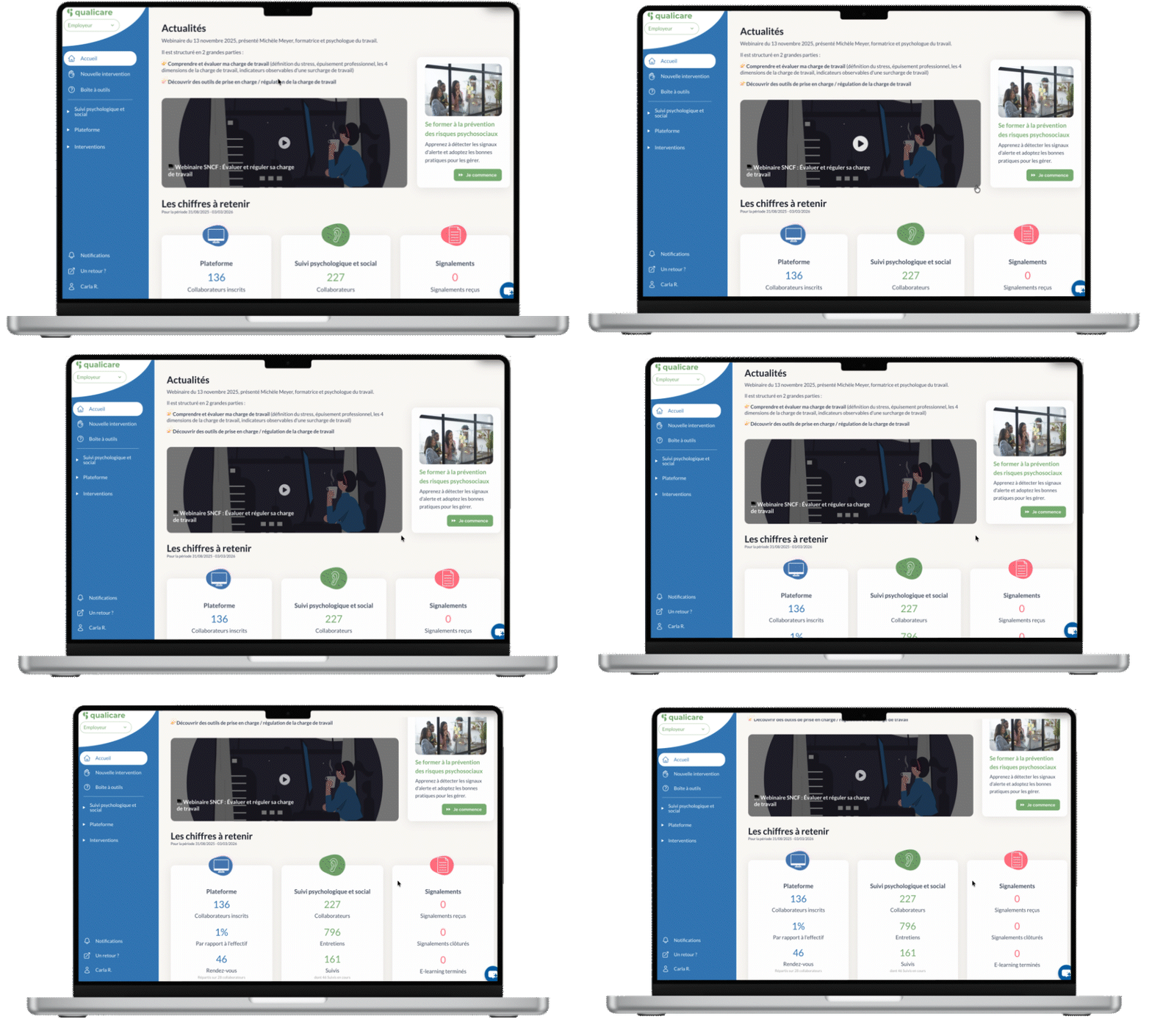
An internal and industry-specific barometer to inform your decisions
Accurately assess workplace morale, engagement levels, and psychosocial risk factors.
Compare your results over time and against industry benchmarks to gauge your organization’s standing and identify priority areas for improvement.
Clear identification of priorities for action
The collected data is analyzed to identify the levers with the greatest impact: workload, recognition, management, team dynamics, purpose… You know where to act first, without spreading yourself too thin.
A targeted and customized action plan
Turn findings into concrete, actionable steps. Each plan is tailored to your specific context, resources, and QVCT maturity level.
Prevention campaigns that can be activated at the right time
Awareness-raising, mental health, management, prevention of psychosocial risks… Deploy structured campaigns to inform, engage, and embed best practices over the long term.
A dedicated dashboard for long-term management
Track your key indicators, measure the impact of your initiatives, and showcase progress to your stakeholders. Primary prevention becomes a strategic and measurable lever, rather than a one-off action.

More than 1100 organizations trust us, why not you?























Our impact
A tangible impact for our customers

“Even in the end, there can be meaning, dignity, and collective courage. A crisis does not reveal what a company does; it reveals what it is. Qualisocial has enabled us to support our employees and HR teams in this human and structured dimension.”

Nadia Ghodhban

“The combination of primary, secondary, and tertiary prevention, with a high level of quality in each program, is fully in line with the support we want to offer our employees. Qualisocial's great strength lies in its ability to combine expertise, human support, and concrete impact across the entire organization.”

Sylvie RECORBET

“Qualisocial supports SNCF Réseau in an innovative approach to mental health in the workplace: listening mechanisms, prevention of psychosocial risks, collective skills development, individual coaching, and digital tools to sustainably enhance the well-being, autonomy, and performance of teams.”

Anne Boucher

“We didn't want a top-down, theoretical training program. Qualisocial offered us a program combining different formats, alternating between content delivery, role-playing, and reflection time. It was a much more dynamic approach, better suited to our realities.”

Linda Breuillet

“The solution offered by Qualisocial provides high-quality support, enabling Groupama to pursue its proactive commitment to promoting quality of life and working conditions and preventing psychosocial risks among employees. A notable feature of the solution deployed by Qualisocial is undoubtedly its agility and responsiveness. Needs are constantly changing, and it is essential to be able to count on a partner capable of supporting these transformations with flexibility and attentiveness.”

Bénédicte Créte-Dambricourt

“The psychological and social worker support hotline is, of course, anonymous. It gives us access to statistics, indicators, and trends, which we can ultimately use to implement concrete and meaningful action plans. So that really helps us a lot.”

Alba Sesma
FAQS
Do you have questions?
What is primary prevention?
Primary prevention involves taking action before psychosocial risks arise, with the aim of reducing stressors, tension, or disengagement. It addresses the causes rather than the consequences, in order to bring about lasting improvements in mental health and quality of life at work.
Primary prevention involves taking action before psychosocial risks arise, with the aim of reducing stressors, tension, or disengagement. It addresses the causes rather than the consequences, in order to bring about lasting improvements in mental health and quality of life at work.
Why should I implement primary prevention in my organization?
Primary prevention helps reduce absenteeism, boost employee engagement, and foster a positive work environment. Primary prevention initiatives also provide managers and HR with reliable data to make informed and targeted decisions.
Primary prevention helps reduce absenteeism, boost employee engagement, and foster a positive work environment. Primary prevention initiatives also provide managers and HR with reliable data to make informed and targeted decisions.
How can we measure the effectiveness of primary prevention?
Through psychosocial risk audits, workplace well-being surveys, and targeted surveys, you can obtain precise indicators of the workplace climate and employees’ mental health. This data allows you to track progress over time and tailor your initiatives to maximize their impact.
Through psychosocial risk audits, workplace well-being surveys, and targeted surveys, you can obtain precise indicators of the workplace climate and employees’ mental health. This data allows you to track progress over time and tailor your initiatives to maximize their impact.
What tools does Qualisocial offer for primary prevention?
We offer psychosocial risk assessments, QualiScore™ surveys, harassment surveys, and impact assessments of organizational changes. Each tool is designed to identify risk factors and propose concrete, actionable plans.
We offer psychosocial risk assessments, QualiScore™ surveys, harassment surveys, and impact assessments of organizational changes. Each tool is designed to identify risk factors and propose concrete, actionable plans.
How long does it take to set up an audit, barometer, or survey?
A Workplace well-being survey is a statistical tool that measures quality of life and working conditions, mental health, and other indicators related to engagement and social climate. It provides you with summary scores and clear dashboards to understand where to take action and track the evolution of your social performance over time.
A Workplace well-being survey is a statistical tool that measures quality of life and working conditions, mental health, and other indicators related to engagement and social climate. It provides you with summary scores and clear dashboards to understand where to take action and track the evolution of your social performance over time.
How can you use the results of these assessments to improve workplace well-being?
The results are presented along with interpretive notes and concrete recommendations. They serve as a foundation for developing or refining your workplace well-being action plan, prioritizing areas for improvement, and engaging stakeholders in targeted and effective initiatives.
The results are presented along with interpretive notes and concrete recommendations. They serve as a foundation for developing or refining your workplace well-being action plan, prioritizing areas for improvement, and engaging stakeholders in targeted and effective initiatives.
Do these assessments allow you to compare your results with those of other organizations?
Yes. Our surveys incorporate industry and national benchmark data, allowing you to see how your results stack up against comparable averages. This benchmarking capability helps you assess your performance and identify the most relevant areas for improvement.
Yes. Our surveys incorporate industry and national benchmark data, allowing you to see how your results stack up against comparable averages. This benchmarking capability helps you assess your performance and identify the most relevant areas for improvement.
%20(1).avif)





.avif)