Preventing absenteeism in the workplace: protecting people and safeguarding performance

+34 %
The sharp rise in absenteeism over the five-year period between 2019 and 2024.
(Source : Barometer WTW 2025.)
.avif)

36%
The proportion of long-term sick leave directly linked to mental health issues.
(Source : Barometer WTW 2025.)

Why is preventing absenteeism a strategic priority?
Disruption and collective impact
Absenteeism leads to an immediate increase in workload, disruption to services and a sense of unfairness among staff who are present.
The impact of long-term absence on employees
For employees, long-term absence leads to isolation, a loss of motivation and a significant risk of anxiety and depression.
Performance and employer brand
Absenteeism rates reached record highs in 2026. Reducing long-term sick leave is essential for developing a sustainable prevention policy (QVCT) and enhancing the organisation’s appeal.


Tailored support to prevent long-term absenteeism
An independent, external and confidential framework
The success of prevention depends on trust. Our scheme guarantees complete impartiality to encourage open discussion:
• Direct access: Employees can seek support independently and on a voluntary basis.
• Confidentiality by default: Discussions are protected. Confidentiality may only be waived with the employee’s explicit consent to coordinate follow-up with the employer.
• A safe space: A place to take stock of one’s health and work situation, in order to clarify one’s options, even well before sick leave is considered.
Aim: To support employees’ career paths and organisational stability
The aim is to strengthen the bond between the employee and the company through multidisciplinary expertise:
• Expert support: Consultations with Qualisocial healthcare professionals (occupational psychologists, social workers, nurses) to provide support before, during and after a period of sick leave.
• Confidential third parties: Supporting the employee’s decisions whilst preserving their anonymity if they so wish.
• Identifying root causes: Identifying early warning signs and organisational causes through the analysis of anonymised data from the interviews.
Developing prevention strategies
To tackle absenteeism holistically, Qualisocial supports companies through a comprehensive transformation:
• Absenteeism committee: Monitoring trends to identify the root causes and tailor interventions accordingly.
• Training for line managers: Equipping managers and HR staff with the tools to identify high-risk situations and take proactive action.
• Organisational adjustments: Support in implementing concrete changes identified on the ground to ensure a lasting impact.
Our impact
A concrete impact with our customers

“Even in the end, there can be meaning, dignity, and collective courage. A crisis does not reveal what a company does; it reveals what it is. Qualisocial has enabled us to support our employees and HR teams in this human and structured dimension.”

Nadia Ghodhban

“The combination of primary, secondary, and tertiary prevention, with a high level of quality in each program, is fully in line with the support we want to offer our employees. Qualisocial's great strength lies in its ability to combine expertise, human support, and concrete impact across the entire organization.”

Sylvie RECORBET

“Qualisocial supports SNCF Réseau in an innovative approach to mental health in the workplace: listening mechanisms, prevention of psychosocial risks, collective skills development, individual coaching, and digital tools to sustainably enhance the well-being, autonomy, and performance of teams.”

Anne Boucher

“We didn't want a top-down, theoretical training program. Qualisocial offered us a program combining different formats, alternating between content delivery, role-playing, and reflection time. It was a much more dynamic approach, better suited to our realities.”

Linda Breuillet

“The solution offered by Qualisocial provides high-quality support, enabling Groupama to pursue its proactive commitment to promoting quality of life and working conditions and preventing psychosocial risks among employees. A notable feature of the solution deployed by Qualisocial is undoubtedly its agility and responsiveness. Needs are constantly changing, and it is essential to be able to count on a partner capable of supporting these transformations with flexibility and attentiveness.”

Bénédicte Créte-Dambricourt

“The psychological and social worker support hotline is, of course, anonymous. It gives us access to statistics, indicators, and trends, which we can ultimately use to implement concrete and meaningful action plans. So that really helps us a lot.”
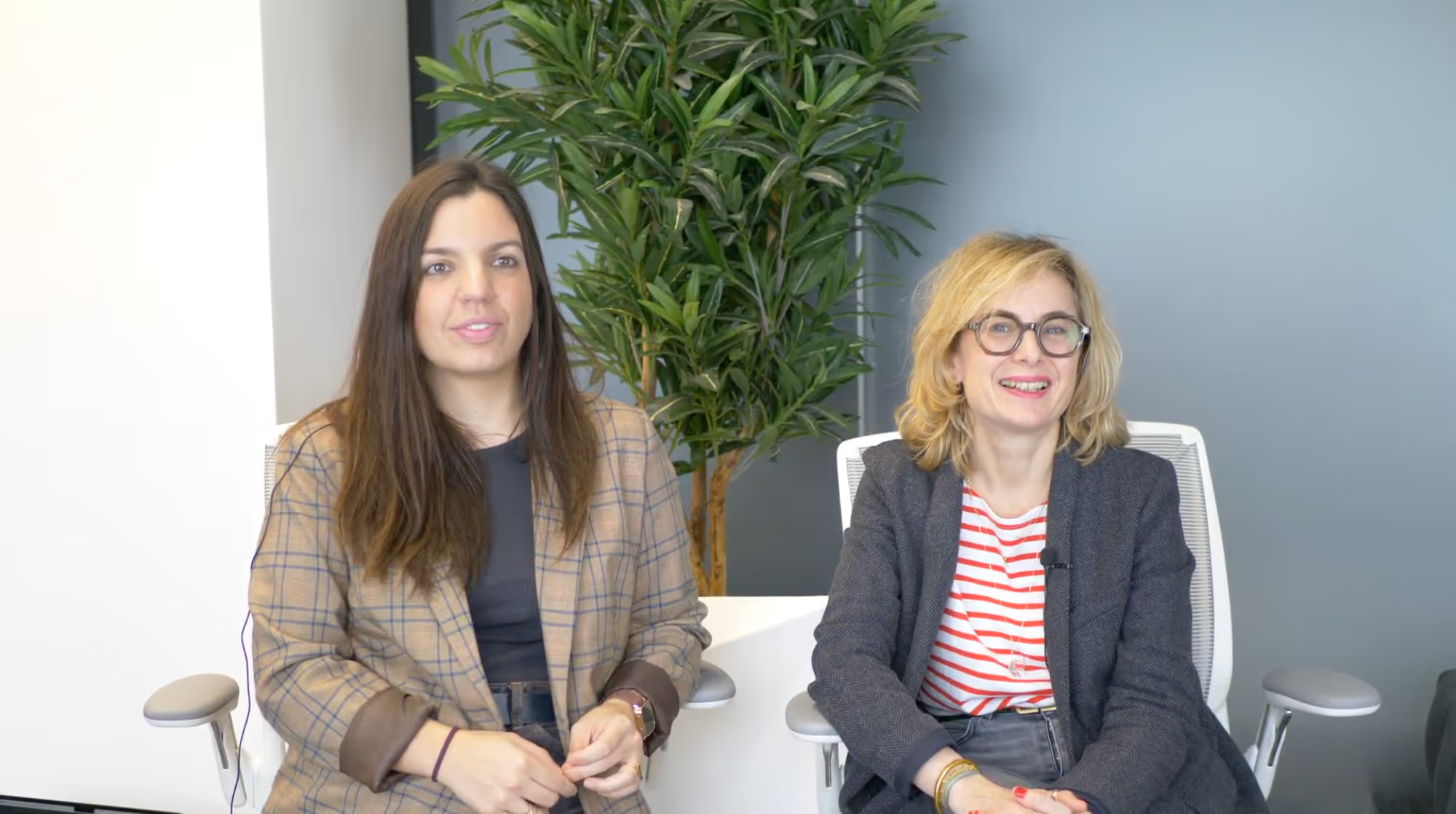
Alba Sesma
Our method: Intervene where everything is at stake
- 150,000 employees accompanied every year.
- 82% of employees say they have solved their problem thanks to our follow-up.
- +70% rate of return or retention in successful employment.


FAQ – Absenteeism in the workplace
Why is prevention essential for reducing absenteeism in the workplace?
Reducing absenteeism is not simply a matter of managing sick leave; it requires addressing the underlying causes before a breakdown occurs. Without structured support, one in four employees relapses after a long period of sick leave. By implementing a strategy to prevent absenteeism, you can identify early warning signs (workload overload, disorganisation, psychosocial risks) and propose practical solutions to maintain your teams’ engagement and well-being.
Reducing absenteeism is not simply a matter of managing sick leave; it requires addressing the underlying causes before a breakdown occurs. Without structured support, one in four employees relapses after a long period of sick leave. By implementing a strategy to prevent absenteeism, you can identify early warning signs (workload overload, disorganisation, psychosocial risks) and propose practical solutions to maintain your teams’ engagement and well-being.
How does the Qualisocial scheme ensure employee confidentiality?
The Qualisocial scheme is independent, external and confidential by default. It is this neutrality that encourages open discussion: employees are provided with a safe space to assess their situation without fear of judgement from their line managers. If the employee wishes, confidentiality may be waived to coordinate follow-up with the employer. For the organisation, we provide analyses based on anonymised data to manage overall prevention without ever compromising individual anonymity.
The Qualisocial scheme is independent, external and confidential by default. It is this neutrality that encourages open discussion: employees are provided with a safe space to assess their situation without fear of judgement from their line managers. If the employee wishes, confidentiality may be waived to coordinate follow-up with the employer. For the organisation, we provide analyses based on anonymised data to manage overall prevention without ever compromising individual anonymity.
What role do managers play in preventing absenteeism on a day-to-day basis?
Managers are on the front line when it comes to detecting subtle individual and organisational warning signs. Qualisocial offers dedicated training to help managers and HR identify at-risk employees and adopt the right approach. The scheme also provides them with expert support: they no longer have to deal with the complexity of human situations alone and can rely on our healthcare professionals to ensure the employee’s journey is supported.
Managers are on the front line when it comes to detecting subtle individual and organisational warning signs. Qualisocial offers dedicated training to help managers and HR identify at-risk employees and adopt the right approach. The scheme also provides them with expert support: they no longer have to deal with the complexity of human situations alone and can rely on our healthcare professionals to ensure the employee’s journey is supported.
What are the practical benefits of an absenteeism prevention policy?
For employees, this means personalised, impartial support to help them overcome their difficulties. For the organisation, the impact is twofold: a reduction in long-term sick leave and the establishment of a sustainable prevention policy. With a success rate of over 70% for returning to or remaining in employment, our method transforms HR data into levers for action to strengthen your employer brand and your company’s overall performance.
For employees, this means personalised, impartial support to help them overcome their difficulties. For the organisation, the impact is twofold: a reduction in long-term sick leave and the establishment of a sustainable prevention policy. With a success rate of over 70% for returning to or remaining in employment, our method transforms HR data into levers for action to strengthen your employer brand and your company’s overall performance.
Who are the experts supporting my staff?
We put together a multidisciplinary support plan in consultation with the employee. Depending on the needs identified during the initial assessment, the employee may be supported by occupational psychologists, social workers, ergonomists, nurses or addiction specialists. This network of experts enables us to address all aspects of absenteeism (health, work organisation, social issues) to ensure a return to work or continued employment in the long term.
We put together a multidisciplinary support plan in consultation with the employee. Depending on the needs identified during the initial assessment, the employee may be supported by occupational psychologists, social workers, ergonomists, nurses or addiction specialists. This network of experts enables us to address all aspects of absenteeism (health, work organisation, social issues) to ensure a return to work or continued employment in the long term.
%20(1).avif)





.avif)