Flew office or the fashion for mobile workspaces

The “without fixed desks” or the fashion for mobile workspaces
Are the “without fixed offices” the new post-pandemic employees? The months of lockdown that followed the global Covid-19 pandemic have significantly affected business organization. During this troubled period, Teleworking has become the rule. Back in the office, many businesses have reconsidered their organization, wanting to take advantage of the benefits of mobility while maintaining human contact.
In a study carried out by the professional furniture manufacturer Deskeo[1], 16% of French companies surveyed are already in flex office, but it is mainly the 55% who are in favor of this new organization that is attracting attention.
The reasons for changing to a layout without a fixed office are multiple, but reducing costs and improving the human experience are the most cited.
Coworking and without fixed offices: making a difference to better understand the concepts
There are many who mix the concepts of flex office and coworking. However, there is a significant difference that should be specified.
In coworking, independent professionals Share a room in order to reduce the burdens associated with the use of space.
On the other hand, the person without a fixed office is an employee within the company. Its biggest particularity is to be able to settle in the area that he wants. Just like the open space worker, he has goals to achieve and tasks to complete, but he will not have a dedicated workstation. The flex office is based on modular office furniture. We can easily combine the offices to meet as a duo, a trio or a larger group. Employees who need calm and concentration are also given the opportunity to isolate themselves.

How does a job “without a fixed office” work?
In a traditional office, everyone settles in at the station assigned to them. In an individual or shared office, but also in an open space, everyone will then take their bearings and can even personalize their space.
In a flex office company, this dedicated workstation is eliminated and is replaced by shared arrangements. Arriving at the office, everyone therefore chooses their space according to their work of the day.
Generally, there are fewer offices in a flex office than there are employees. In fact, assuming that an office is only used 60% of the time, rotation between users makes it possible to optimize the time of use of the workspace. Because if he does not need to travel, a worker can remain teleworking. In a traditional context, he will therefore have left his office empty. This is also the case for certain professional categories who are required to travel often. The sharing of the workspace makes it possible to optimize its use.
Flex office to improve the human experience within the company
Successive lockdowns have demonstrated the advantages and limitations of remote working. For some missions, it is not necessary to waste time in transport. Despite everything, it is essential to be in person regularly to maintain human contact between employees and with managers.
The flex office therefore takes advantage of both worlds by reconciling mobility and interaction.. Many large companies have already taken the plunge: Bouygues Telecom, Danone, Axa... We then often talk about campuses, as the head offices of high-tech giants (Google, Facebook, Apple...) are also called.
With the establishment of a layout without a fixed office, the Paper often gives way to cloud technologies. It is indeed difficult to get around with dozens of printed documents. Dematerialization makes it possible to make up for the absence of paper. At the same time, it considerably reduces the company's carbon footprint. In particular, we prefer mobile terminals that consume much less energy than desktops.
Setting up a space without a fixed office generally relaxes the relationship between the management team and the employees. The absence of a rigid framework embodied by the assigned positions facilitates communication between hierarchies. Also, employees tend to settle down by affinity. The atmosphere is therefore friendlier, a significant plus for well-being at work.
Without a fixed office: a radical change
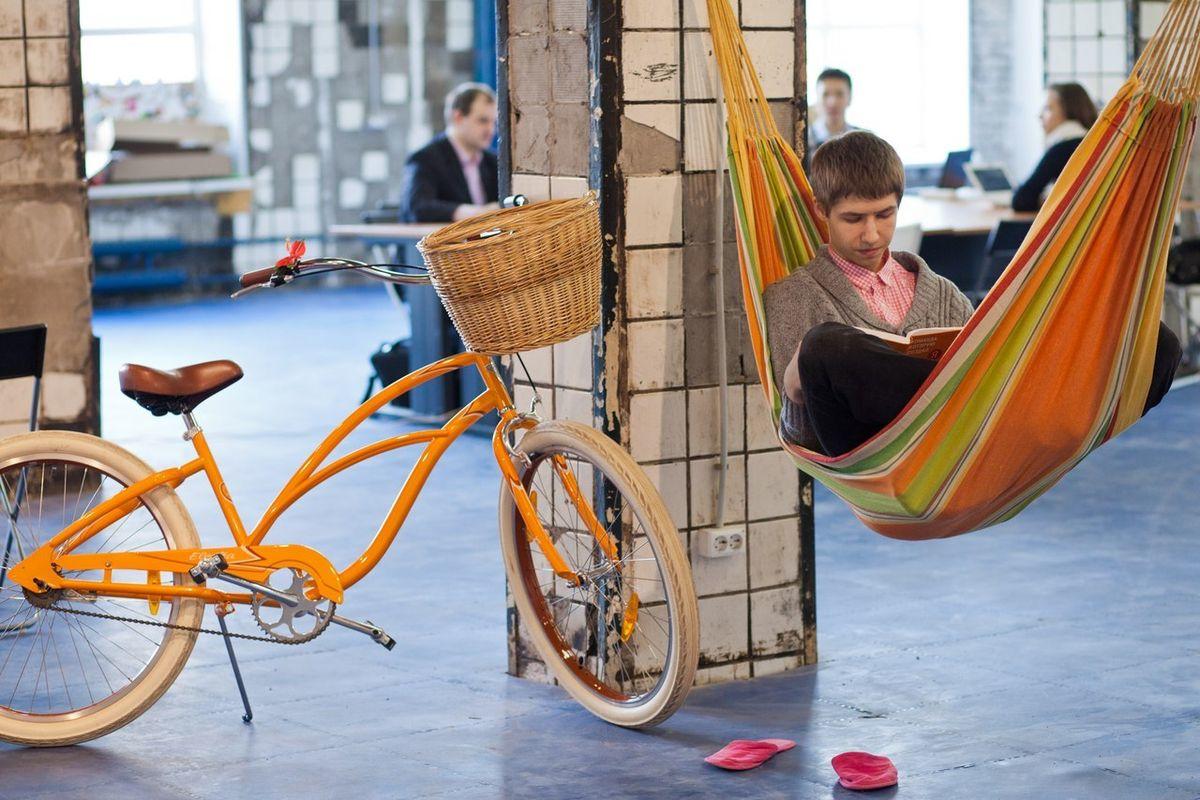
Credit: Courrier International
Going from a spatial organization to a nomadic configuration is a radical change. It's not just about changing places. The entire corporate culture will have to be turned upside down. This new approach is a challenge to decades of traditions. While teleworking has become democratized, despite our will, the Implementation of a concept without a fixed office must be done on a voluntary basis.
Without employee buy-in, the process of switching to the system without a fixed office will quickly be doomed to failure. The employee must in fact be able to apprehend the absence of a fixed anchor point within the company. Until today, the office represents in fact the Link between the employee and the workplace. In a way, this is what guarantees him job security.
By opting for a model without a fixed office, it will be necessary to set up another link that clearly means that the employee is a full member of the structure. Many companies have in fact installed name lockers to materialize this bond of belonging. Communication and pedagogy work is mandatory prior to the adoption of the flex office.
Constraints to consider when choosing mobile workspaces
The first infrastructure to be put in place to ensure the smooth functioning of the flex office is the Wifi network. It should be accessible and comfortable to use. It is indeed unthinkable to connect to an Ethernet outlet. In addition to cable management, connection during busy days becomes a problem. At the same time, we must Multiply electrical sources to allow everyone to charge their devices.
Setting up without a fixed office does not hide the formal nature of the business. Meeting rooms, as well as workspaces, need to be managed effectively. to avoid the risk of conflict. Without a clear rule, it often happens that an employee reserves a seat next to his own for his colleague. In the end, friction may arise from choosing the location among those available. It will therefore be necessary to think of a fair reservation and allocation system so that everyone can really find something for themselves in nomadism.
Finally, a company without fixed offices will have to rethink your management system. How do you manage when you don't know the exact location of your employees? How do you communicate? What is the optimal layout? At present, there is no ready-to-use solution yet. Each structure will begin the shift according to its current human resources needs and its future prospects.





%20(1).avif)






.avif)