Super teams vs average teams: 7 inspiring lessons from Luis Enrique to boost your teams
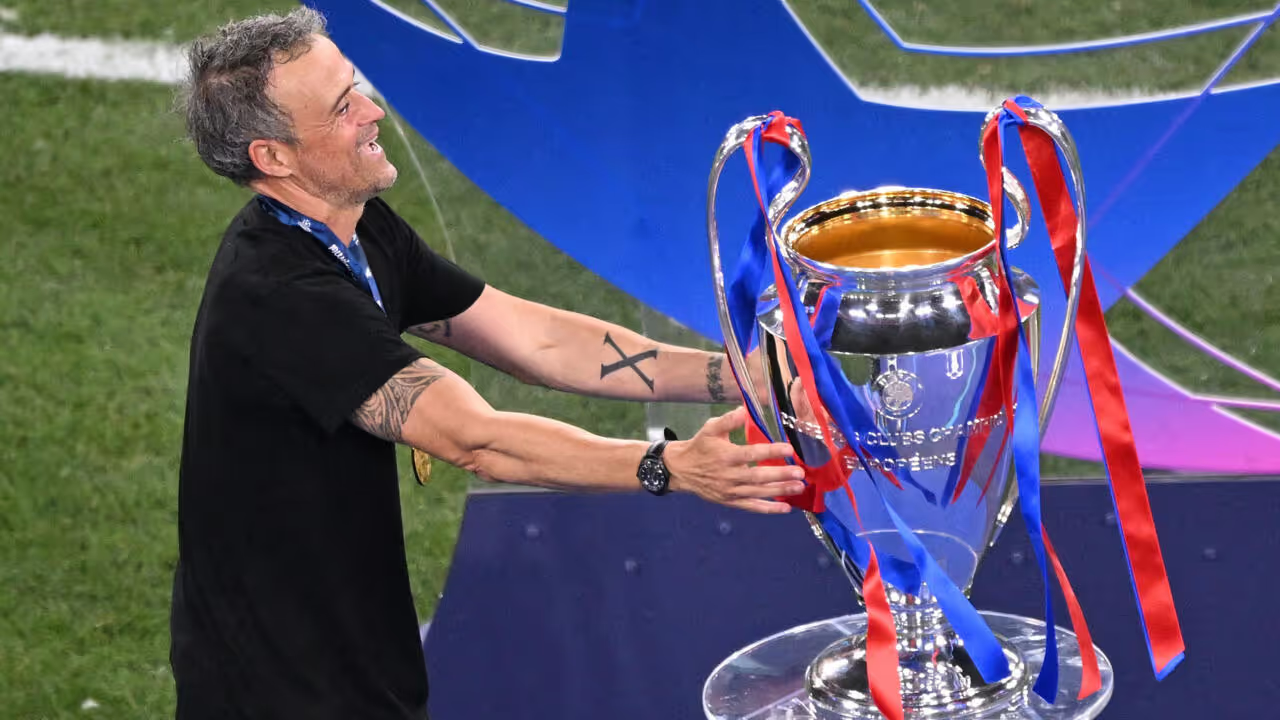
What if HR directors could Be inspired by a soccer coach to help their teams grow ?
At first glance, Luis Enrique and HR issues don't have much in common. And yet... in a few months, This discreet coach transformed PSG, a club used to individual stars, in a team that is more cohesive, more agile, and above all more efficient. How? By putting the collective at the center, by promoting versatility, and by breaking fixed hierarchies.
What we are interested in here is not the ball, but the way to create a strong group dynamic, in a complex environment, under pressure, with very varied profiles. In short: a daily life that many HR directors know well, whether at the head office or in the factory.
In this article, we share 7 concrete lessons to learn from the Luis Enrique method and his true taste for team play. Simple, human levers of action that can feed your managerial and HR practices.

1. Understanding the other through internal mobility
At Luis Enrique, no player remains locked in his role. An attacker can end up at the side, a defender mounted in the middle. Not to put them in trouble, but to Help them progress and make them see the game differently.
The result: players who are more agile, more tactically intelligent, and above all more united.
And in business?
This logic applies wonderfully, especially in organizations where the headquarter and field worlds don't communicate very well. Offer an employee to spend a day in another department, or at a manager to discover the reality of a position in a factory, that changes everything.
That's what we call the Job rotation Or the “Live my life” professional :
- It breaks the silos;
- Increase skills;
- Creates mutual recognition.
Understanding what the other person is experiencing is the first step towards a functioning collective. And that doesn't require weeks of training: a day of immersion is often enough to generate ideas, respect and cooperation.
2. Benevolent standards at the heart of the collective
” Your involvement is low. ” Not:” You suck. ”
At Luis Enrique's house, We don't judge the person, we question the level of commitment. And that changes everything.
In a team, rigor is essential. But what makes the difference is The way to express it. The Spanish coach is known for his extreme standards... without ever humiliating or pointing fingers. He's talking about behaviors, not identities. It fits without breaking.
And in business?
For HR, this is a key area: train managers to give constructive feedback, without injury or avoidance. A simple”bravo“or”Can do better“is not enough. The Feedback must be:
- Regular (not just at the annual maintenance);
- Accurate (grounded in facts);
- Looking to the future (“how do we move forward together?”).
💡 Good news: employees are asking for it.
In fact, 80% of employees believe that regular feedback improves their Motivation at work (source: study deloitte). And when the feedback is well done, it reinforces trust, progress... and team cohesion.
👉 To remember: to be demanding is not to be hard. It means being clear, fair and focused on collective progress.
3. Work hard and recharge together
Luis Enrique is known for his work intensity. He spends whole days at the club, observes everything, details everything... but also knows how to take breaths. Not alone, no: with his staff, around a paddle match. Why? Because that's where they're built trust, complicity, and the desire to excel together.
And in business?
We value commitment, performance and productivity a lot (and rightly so). But we often forget that Collective health is also at stake in informal moments. Those who are not “useful” on paper... and who change everything on the ground.
Lunch with another team. Sharing a coffee without an agenda. Set up a sports challenge or a joint walk. These are all breaths that allow us to get to know each other better, to create trust... and therefore to work better together.
3 simple ideas to test
- The “Rh-Prod already crossed” : Once a month, have lunch together for employees from headquarters and the field, or from various teams, without challenges or pitches. Just to talk.
- The “15 minutes without pressure” : block a short time slot every week (in video or on site) for a collective, non-productive moment... but nourishing.
- An “active break” led by the employees themselves : sport, DIY, quiz... regardless of the activity, the main thing is to create a common, living and shared space.
👉 To remember: taking care of collective energy is not about slowing down performance, it's about making it sustainable.
4. Take a step back to make better decisions
Luis Enrique does not spend all his days in the hustle and bustle of the dressing room or on the field. He regularly tunes in time alone, walking, or biking. It's not an escape. It is Taking a step back to make better decisions.
He also observes the training sessions from a high point, literally, to gain height. Result: fewer hot reactions, more relevant decisions.
And in business?
How many decisions are taken urgently, between two meetings, without real hindsight? However, The brain needs emptiness to think right. Especially when you manage diverse teams, between headquarters and field.
What can we put in place, without revolutionizing the agenda
- Slots without meetings (really respected) : 1 half-day per week to think, structure, breathe.
- An HR “high point” : once a month, get away from daily life to observe the team as a whole (social climate, field feedback, weak signals, etc.).
- Breathing times for managers : support, coaching, or simply time planned in their schedule to think about their posture.
👉 To remember: A good decision is not (always) a quick decision. It is a well-thought-out, aligned, and assumed decision.
5. The collective before the individual stars
Luis Enrique dared to do the unthinkable: leave on the bench (or even leave sometimes!) top players, too focused on themselves, not collective enough. With him, there is no room for the misplaced ego and individualism, even talented. What matters? The impact on the group. End point.
And in business?
We often celebrate the “stars”, the “top performers”, the “ultra-involved”. What if we also valued those who move the team forward, not just their own agenda? The smugglers, the supporters, the discreet, without whom nothing holds up.
Concrete levers to put the collective back at the center
- Changing the evaluation criteria : integrate items related to cooperation, mutual assistance, and impact on the team in annual interviews.
- Create a “collaborative spotlight” : a person valued each month for their team spirit (cross-feedback, internal voting, managerial recognition...).
- Highlighting team successes, not just individual ones: internal newsletters, monthly meetings, celebration rituals.
A Deloitte study reveals that organizations that value collaboration have 5 times more likely to be high-performing.
👉 To remember: When we value collective behaviors, we do not sacrifice performance: we anchor it over time.
6. The organization of energy and exchanges
Luis Enrique does not reveal his tactics Only a few hours before the matches. Even to his staff. Why? For avoid endless debates, over-interpretations, the dispersion of energy.
What he is looking for is aligned action, not lukewarm consensus. And it works: less confusion, more clarity.
And in business?
Meetings that last, long emails, Slack loops that follow one another without clear decisions... Does that speak to you? La surcharge cognitive linked to fuzzy or overly abundant communication Exhaustive the teams and interferes with their effectiveness.
Reflexes to adopt for communication that is more useful than noisy
- Clarify the goals of each meeting : inform, decide or create? One intention at a time.
- Limit speaking time to encourage conciseness and clarity.
- Take “process breaks” as a team : how do we communicate? Is it fluid, clear, useful? Adjust together.
According to an Atlassian study, Employees spend an average of 31 hours per month in useless meetings.
👉 To remember: good work organization also means good energy management. Less noise, more impact.
7. Rigor and positive discipline
Luis Enrique is known for his Uncompromising discipline : an uninvolved player? He is discarded. Late? He goes out. But the strength of its management is its ability to set a demanding framework without ever attacking the person.
Once again: “Your involvement is low” rather than “you suck”.
Rigor then becomes a mark of respect.
And in business?
A clear framework is often seen as restrictive. However, it is the condition for teams to feel safe... and responsible. Too much vagueness or poorly calibrated flexibility creates inequity, frustration, and even exhaustion.
Three levers for fair and constructive discipline
- Rethinking the role of the manager as guardian of the framework, not simply executing the management.
- Train in factual, non-judgmental feedback, to defuse tensions.
- Assume consistent collective rules : flexibility does not exclude justice.
A study of Gallup shows that employees who know exactly what is expected of them are 2.7 times more engaged.
👉 Remember: discipline is not the enemy of well-being. When it is clear, fair and explained, it becomes a driver of performance... and trust.


7 lessons, 1 same philosophy: that of a strong, aligned, moving collective.
Let's recap:
- Understanding the other by stepping out of his usual role.
- Demanding without blaming, with feedback that elevates.
- Working hard but together, preserving informal moments.
- Take a step back to make better decisions.
- Valuing the collective rather than the egos.
- Channel energy, avoid sterile debates.
- Establishing fair rigor, without dehumanizing.
Don't these principles come from the HR world? Maybe. But they resonate with a very current HR problem : How to create a demanding, efficient working environment... and respectful of human balances?
What if we drew a parallel with mental health? What Luis Enrique does is protect energy, clarify the rules, encourage the collective. What can you do as HR? Exactly the same thing.
At Qualisocial, we see it every day: An employee who understands the environment, who has the right to breathe, who feels recognized for his contribution to the collective is an employee who is doing well.
And when the teams are doing well, the company performs better.
So why not test one of these levers this week? An exchange between departments, a shorter meeting, clearer feedback, a better defined rule.
Sometimes you don't have to revolutionize everything. Juste Dare to make some inspired adjustments... of a soccer field.




%20(1).avif)



.avif)